


ENORA-AI Functional Requirements — Automotive Quality Engineering Capabilities
F1: Project Quality Score
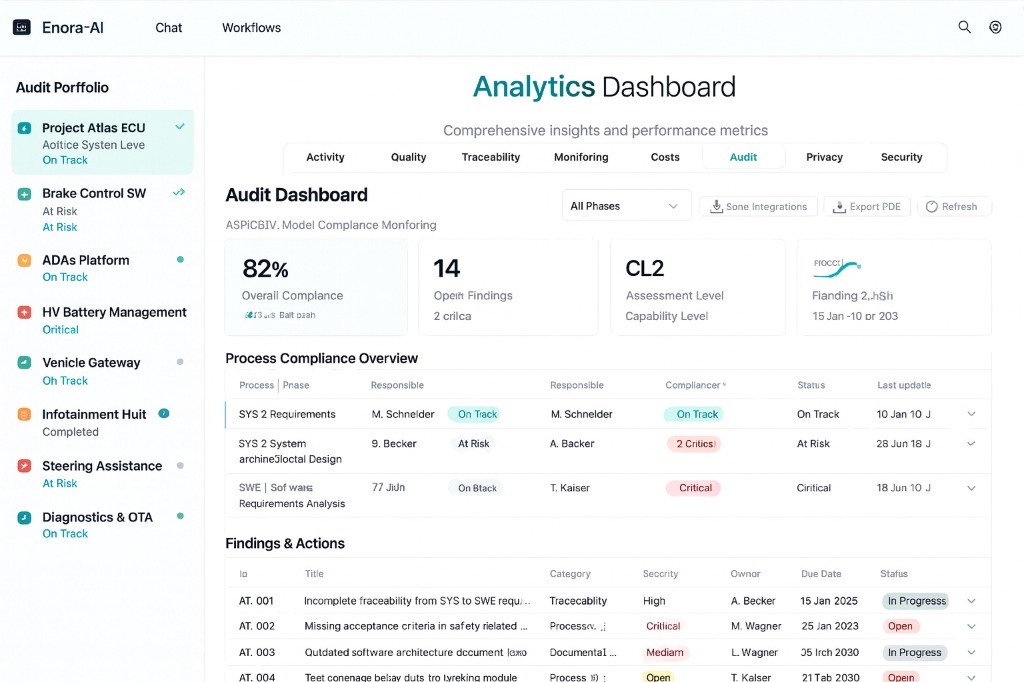
System displays per-project quality score based on coverage, defects, open findings and compliance status. Drill-down from OEM-Requirement to test case with full traceability chain.
System zeigt pro Projekt einen Quality-Score basierend auf Abdeckung, Defekten, offenen Findings und Compliance-Status. Drill-down von OEM-Anforderung bis Testfall mit vollstaendiger Traceability-Kette.
F2: Continuous Work Product Generation
Automated generation of engineering artifacts: Requirements-Refinement, Safety-Analysis-Templates (FMEA, HARA), Test-Case-Skeletons. Template-based document generation with versioning and change protocol.
Automatisierte Generierung von Engineering-Artefakten: Requirements-Refinement, Safety-Analyse-Templates (FMEA, HARA), Testfall-Skeletons. Template-basierte Dokumentengenerierung mit Versionierung und Aenderungsprotokoll.
F3: Compliance Checkpoints
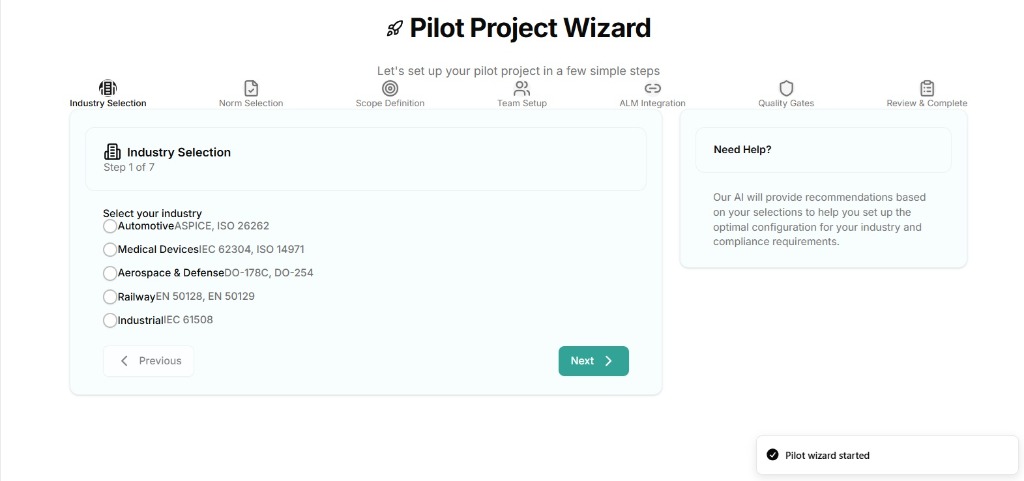
Configurable ASPICE/ISO profiles per project. Quality Gateway with automated validation at each V-Model phase. Policy-driven governance via OPAL/OPA integration with less than 5 seconds validation time per phase.
Konfigurierbare ASPICE/ISO-Profile pro Projekt. Quality Gateway mit automatisierter Validierung in jeder V-Modell-Phase. Policy-gesteuerte Governance via OPAL/OPA-Integration mit weniger als 5 Sekunden Validierungszeit pro Phase.
F4: API-based Tool Integration
Universal ALM Connector Framework supporting Jira, Azure DevOps, GitHub, GitLab, ServiceNow, Confluence, DOORS, and Polarion. REST API and OSLC standards. Read-only overlay, no data migration required. First baseline in days, not months.
Universelles ALM-Connector-Framework fuer Jira, Azure DevOps, GitHub, GitLab, ServiceNow, Confluence, DOORS und Polarion. REST-API und OSLC-Standards. Read-Only-Overlay, keine Datenmigration erforderlich. Erste Baseline in Tagen, nicht Monaten.
F5: Governed Multi-Agent AI Orchestration
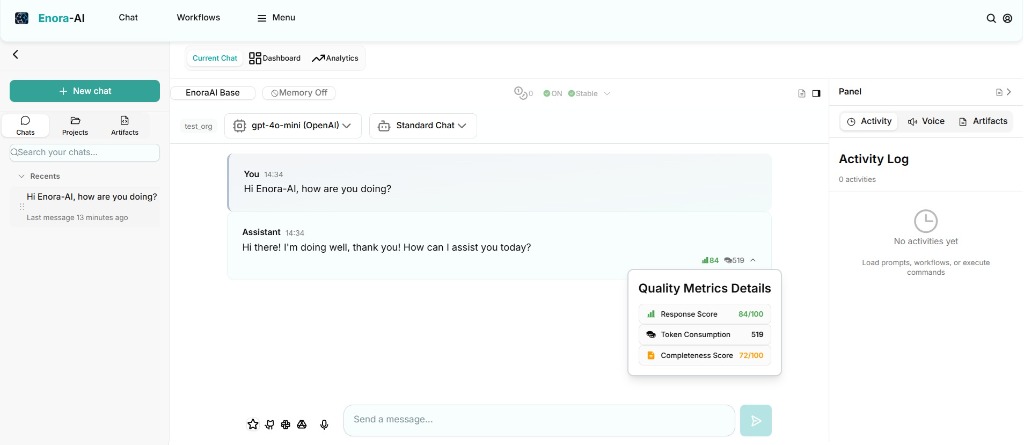
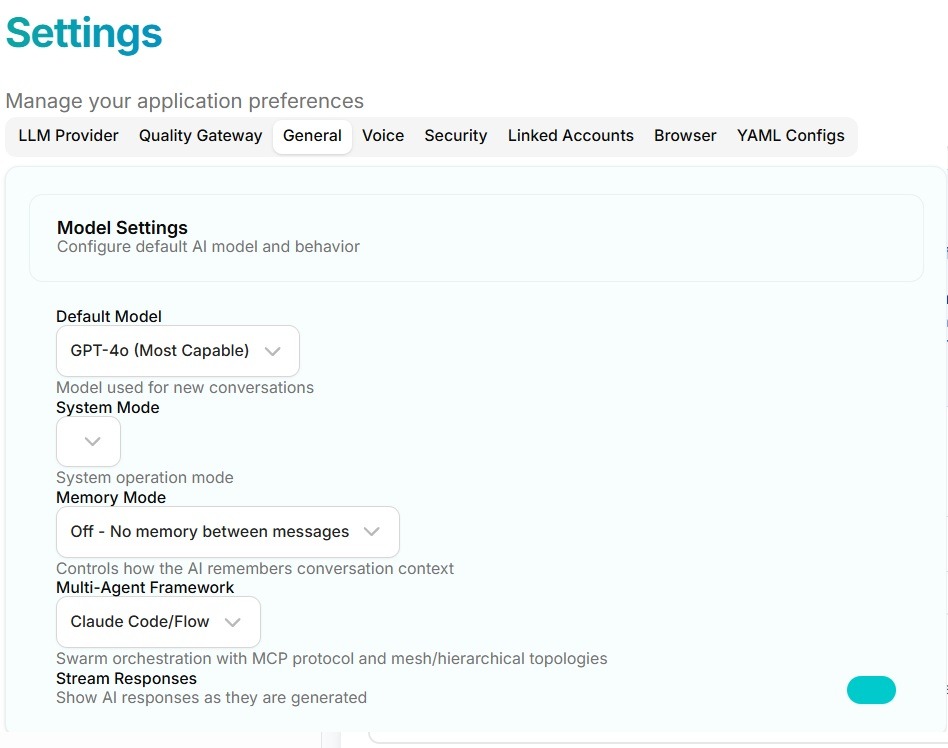
16+ specialized AI agents (Parsing, Linking, Drafting, Review, Gap Analysis). Multi-provider LLM Router supporting 19 providers (OpenAI, Anthropic, AWS Bedrock, Azure OpenAI, Google Gemini, Mistral, Ollama). Full audit logging with prompt/context/output traceability. Agent consensus mechanism with greater than 80% agreement rate.
16+ spezialisierte KI-Agenten (Parsing, Linking, Drafting, Review, Gap-Analyse). Multi-Provider LLM-Router mit 19 Providern (OpenAI, Anthropic, AWS Bedrock, Azure OpenAI, Google Gemini, Mistral, Ollama). Vollstaendiges Audit-Logging mit Prompt/Context/Output-Nachvollziehbarkeit. Agenten-Konsensus-Mechanismus mit ueber 80% Uebereinstimmungsrate.
F6: Automated Gap Analysis
AI-driven compliance gap detection across all connected tools. Automatic identification of missing traceability links with 98.87% semantic recovery accuracy. Risk scoring per gap with severity classification.
KI-gesteuerte Compliance-Gap-Erkennung ueber alle angebundenen Tools. Automatische Identifikation fehlender Traceability-Links mit 98,87% semantischer Wiederherstellungsgenauigkeit. Risikobewertung pro Gap mit Schweregrad-Klassifikation.
F7: V-Model Workflow Engine
7-phase V-Model execution with TPARR methodology (Think, Plan, Act, Review, Repair). Dynamic workflow generation based on project type and compliance requirements. WebSocket real-time updates. Complete workflow execution in under 15 minutes.
7-Phasen V-Modell-Ausfuehrung mit TPARR-Methodik (Think, Plan, Act, Review, Repair). Dynamische Workflow-Generierung basierend auf Projekttyp und Compliance-Anforderungen. WebSocket-Echtzeit-Updates. Vollstaendige Workflow-Ausfuehrung in unter 15 Minuten.
F8: Findings Feedback Loop
Findings automatically reflected back into source systems (Jira/Polarion tickets). AI-driven correction suggestions with fix proposals. Reviewer assignment and approval workflows for changes.
Findings werden automatisch in Quellsysteme zurueckgespiegelt (Jira/Polarion-Tickets). KI-gestuetzte Korrekturvorschlaege mit Fix-Proposals. Reviewer-Zuweisung und Genehmigungs-Workflows fuer Aenderungen.
F9: Configurable Guardrails
Maximum change scope per AI action, mandatory review requirements, blocklists for sensitive areas. Policy-driven governance ensures AI modifications stay within defined boundaries. Every AI-modified entity is traceable including before/after state.
Maximaler Aenderungsumfang pro KI-Aktion, Pflicht-Review-Anforderungen, Verbotslisten fuer sensible Bereiche. Policy-gesteuerte Governance stellt sicher, dass KI-Modifikationen innerhalb definierter Grenzen bleiben. Jede KI-modifizierte Entitaet ist nachvollziehbar inklusive Vorher/Nachher-Zustand.
F10: Audit Report Export
Export of audit reports (PDF/Docx) with artifact references and evidence chains. Immutable audit logs with 7-year retention. Automated evidence collection for assessor preparation.
Export von Audit-Berichten (PDF/Docx) mit Artefakt-Referenzen und Nachweisketten. Unveraenderbare Audit-Logs mit 7 Jahren Aufbewahrungsfrist. Automatisierte Evidenz-Sammlung fuer Assessor-Vorbereitung.
F11: Security Analysis Hub
TARA (Threat Analysis and Risk Assessment) per ISO/SAE 21434 Clause 15. STRIDE/DREAD threat modeling. FMEA and HARA safety analysis. Attack surface analysis with CAL levels (1-4). Attack feasibility rating across five dimensions.
TARA (Bedrohungsanalyse und Risikobewertung) gemaess ISO/SAE 21434 Klausel 15. STRIDE/DREAD-Bedrohungsmodellierung. FMEA- und HARA-Sicherheitsanalyse. Angriffsoberflaechen-Analyse mit CAL-Stufen (1-4). Angriffsdurchfuehrbarkeits-Bewertung ueber fuenf Dimensionen.
F12: ASPICE 4.0 Native Support
Native support for all ASPICE 4.0 process groups: SWE (Software Engineering, 7 processes), MLE (Machine Learning Engineering, 6 processes — NEW), HWE (Hardware Engineering, 5 processes — NEW), VAL (Validation, 4 processes — NEW), SUP (Supporting Processes). Training data to model to validation traceability for ML projects.
Native Unterstuetzung aller ASPICE 4.0 Prozessgruppen: SWE (Software Engineering, 7 Prozesse), MLE (Machine Learning Engineering, 6 Prozesse — NEU), HWE (Hardware Engineering, 5 Prozesse — NEU), VAL (Validierung, 4 Prozesse — NEU), SUP (Unterstuetzende Prozesse). Trainingsdaten- zu Modell- zu Validierungs-Traceability fuer ML-Projekte.
F13: Authentication & Multi-Tenant Architecture
OAuth2/OIDC/SAML SSO, JWT tokens, RBAC with 4 roles, MFA/2FA, Magic Link authentication. Multi-tenant isolation with tenant-specific data partitioning across 10,000+ organizations. ABAC (Attribute-Based Access Control) for fine-grained permissions.
OAuth2/OIDC/SAML SSO, JWT-Tokens, RBAC mit 4 Rollen, MFA/2FA, Magic-Link-Authentifizierung. Multi-Tenant-Isolation mit mandantenspezifischer Datenpartitionierung fuer ueber 10.000 Organisationen. ABAC (Attributbasierte Zugriffskontrolle) fuer feingranulare Berechtigungen.
F14: Neuro-Symbolic AI Architecture
Hybrid architecture combining Generative AI (LLMs for parsing and drafting) with Symbolic AI (formal logic for verification). Traceability Graph: Requirement to Code to Test with inspectable links. If evidence is missing, it is flagged as a gap — never hallucinated. Unintended Change Prevention Protocol (UCPP) ensures AI modifications are bounded.
Hybride Architektur aus Generativer KI (LLMs fuer Parsing und Drafting) und Symbolischer KI (formale Logik fuer Verifikation). Traceability-Graph: Anforderung zu Code zu Test mit inspizierbaren Links. Fehlende Evidenz wird als Gap markiert — nie halluziniert. Unintended Change Prevention Protocol (UCPP) stellt sicher, dass KI-Modifikationen begrenzt sind.
F15: Cost Optimization & Provider Management
Multi-provider LLM cost optimizer with automatic provider switching and budget controls. 30-50% LLM cost savings through intelligent routing. Resource limits per job to prevent runaway costs. Cache hit rate target greater than 80%.
Multi-Provider LLM-Kostenoptimierer mit automatischem Provider-Wechsel und Budget-Kontrollen. 30-50% LLM-Kosteneinsparung durch intelligentes Routing. Ressourcenlimits pro Job zur Vermeidung unkontrollierter Kosten. Cache-Hit-Rate-Ziel ueber 80%.